
Why Evolutionary Challenges to Moral Realism Fail
A response to the most common — and most compelling — anti-realist objection

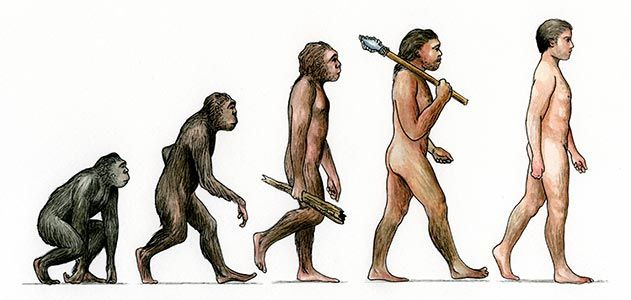
There are only a handful of objections to moral realism that I find interesting at all, and of those few, just one has ever really made me nervous. It has to do with the role of evolutionary pressures in explaining the moral judgments we make — the worry is that, if we really can account for morality in purely evolutionary terms, then belief in objective moral facts becomes superfluous. As a committed naturalist, this challenge hits me with an undeniable force, especially since I think so many popular views in philosophy of mind and religion go wrong precisely because they ignore the influence of natural selection on our beliefs about the world. Nevertheless, in this piece, I want to give a fairly lengthy explanation for why I’m still not convinced that evolutionary challenges like these can give us good reason to doubt the truth of moral realism.
Although there are many different versions of the challenge I have in mind, the most common form goes something like this: Evolutionary pressures explain why we think certain things are morally good, bad, righteous, blameworthy, and so on; but that evolutionary explanation doesn’t require that any actual objective moral facts exist; and since we can explain our moral judgments perfectly well without invoking that objective moral reality, introducing objective moral facts into the theory would be explanatorily unnecessary; so therefore, on parsimony grounds, we have no good reason to believe those objective moral facts exist. This is easily the most common objection I see aimed at moral realism, and many critics clearly see it as decisive.
First, let me say a few words on what I don’t find concerning about this objection, which is the specifically evolutionary context it’s framed in. For a number of reasons, I think we should all be very skeptical of evolutionary psychology’s ability to actually provide a full explanation for moral judgments in purely Darwinian terms — much less one that clearly out-competes any alternative realist account. No explanation like that is anywhere close to existing today, and barely any anti-realists have even tried to make a real case for why we should think it’s waiting in the future. So on that basis alone, I would say moral realists would be well within their rights to just reject the first premise of the challenge, or at least defend taking an agnostic position until evolutionary psychology has developed further.
So what, then, is concerning? My worry is that, while evolutionary pressures on their own aren’t enough to do the job, we could broaden the category a bit to include all the other psychological, cultural, and historical influences that also play some role in our moral judgments — and it’s this expanded set that might really pose an explanatory challenge. So even if natural selection (probably) isn’t enough to make objective moral facts superfluous by itself, its influence might still be a meaningful chunk of whatever overall explanation does have a good shot at ruling them out. This means evolutionary objections ultimately reduce to a much broader challenge: How can we defend the role of objective moral facts in an explanation for our moral beliefs, when so many other non-moral options are available?
For this reason, it’s better to think of evolutionary explanations as also including, at least hypothetically, all of the other influences that might play a part in any full non-moral explanation of the moral judgments we make. (Uri Leibowitz and Neil Sinclair call this an “evolutionary+” explanation in their terrific paper on the subject, which I’ll be drawing from throughout this piece.) But it should be obvious by now that this expanded set of influences is deeply intertwined with every possible aspect of human thought, as opposed to just our moral judgments. So if it really is the case that natural selection can function as an all-purpose explanatory replacement for the actual truth of any belief it’s produced, then the result of that logic would be global skepticism, not just a rejection of objective moral facts in particular.
But of course, that conclusion is too radical, since many of our beliefs have obviously developed as a result of evolutionary pressures while still being beyond any reasonable suspicion. And that’s because, for those beliefs, we see their truth plays a part in why it is that we hold them. Since natural selection has played a major role in developing our perceptual faculties, for example, it must also have played a major role in why it is that we believe in the existence of trees and rocks and other physical objects. But we evolved to make those judgments because trees and rocks and other physical objects actually exist, and knowing they exist was (and is) helpful for survival. So if critics of moral realism want their challenge to succeed, they need to show that an evolutionary explanation for our moral judgments isn’t like this — that is to say, they need to show that the best explanation for why it is we believe what we do about morality doesn’t involve any reference to objective moral facts actually existing.
Many anti-realists seem to believe that this is obviously the case, but nailing down what it means for a second-order moral property to be “involved in” or otherwise contribute to an explanation is more difficult than people tend to imagine. Consider, as an example, facts about what is and isn’t pathogenic. Does an “objective health fact” like this play a role in evolutionary explanations of our predisposition to avoid eating rotten meat? On one reading, the answer is obviously yes — the reason it was evolutionary advantageous for us to develop that aversion is because rotten meat is objectively pathogenic for human beings. But on another reading, the evolutionary pressures were instead acting only in response to entirely “health-neutral” facts about the first-order consequences of eating rotten meat, which facts about pathogenicity (assuming they do exist) only supervene on.
This reductive, “first-order only” explanatory approach may be internally consistent, but it has the radical consequence of ruling out belief in any second-order properties at all, collapsing us back into (at least a large portion of) the generalized skepticism we previously discussed. In fact, because it would also rule out the explanatory power of many second-order properties like fitness or kinship, the same approach would be self-defeating for an advocate of the evolutionary challenge anyway. So assuming the critic of moral realism wants to avoid internal contradictions, and wants to maintain their justified belief in at least some of the hundreds of second-order properties we find explanatorily valuable, then it clearly won’t do to write off objective moral facts simply because, theoretically, it would be possible for an evolutionary explanation to function without them.
This is the first major error of the evolutionary challenge as it’s often presented: It frames objective moral facts as illegitimate simply because they can be excluded from a functional evolutionary explanation, even though that sort of exclusion is at least theoretically possible for any second-order property. But once we move past a general opposition to the explanatory power of second-order properties as a class, and instead focus on what objective moral properties in particular might be capable of explaining, the assumption that those properties would “bring nothing to the table” is far from obvious. So let me now sketch out why it is that I think objective moral properties do plausibly earn their place in our evolutionary explanations, for roughly same reason we’re justified in accepting the existence of objective facts about health.
To begin making my case, let’s return to pathogenicity for a moment — why is it that we’re justified in accepting the existence of a property like that, and relying on it in evolutionary explanations, if an alternative explanation that relies only on first-order facts is available? The obvious answer is that adopting facts about pathogenicity as an explanatory resource makes our explanations better overall, even when we factor in the theoretical cost of slightly inflating our ontology. It would take too long to offer a full analysis of what exactly justifies adopting new theoretical postulates in general, of course, but I’ll take a moment here to at least lay out two key features that help make the case in this context.
The most important consideration, in my mind, is that accepting second-order facts about pathogenicity allows us to answer essential modal questions about necessary and sufficient counterfactual conditions, which play an ineliminable role in basically all explanatory work. A reasonable standard to have for any explanation is that (absent some irrelevant complications) the event being explained wouldn’t have taken place in the absence of whatever it is you’re relying on to explain it; in other words, if X truly explains Y, then it should generally be the case that, in the closest possible world in which X is not the case, Y is also not the case. Explanations that struggle to meet this requirement often strike us an intuitively absurd and unreliable. Saying that water on the floor is explained by a broken sink, for example, but that the water would be there even if the sink wasn’t broken, is just failing to explain the water on the floor at all.
Returning to the earlier question of why it is we evolved to have an aversion towards rotten meat, we see that this standard complicates a “first-order only” explanation. If we attempt to account for this aversion by referencing the wildly complex, disjunctive set of all first-order facts that ultimately played any evolutionary role — in this case, all the various bacteria and pathogens that were actually present in all the rotten meat throughout history and their combined impact on our ancestors — then we can easily see that all the closest possible worlds in which this set is minimally altered still have humans developing the same sort of aversion, since that minimally altered set would also result in evolutionarily disadvantageous harms. And this significantly undercuts the explanatory relevance of that first-order set, since what’s being explained would have occurred even without it.
But if, on the other hand, we try to explain the development of our aversion with the fact that rotten meat is pathogenic, the counterfactual test is now successful. In the closest possible world in which that pathogenic quality is absent — a world in which rotten meat posed no major risk of disease — evolutionary pressures would not have led us to develop the aversion in question. For this reason, the fact that rotten meat is pathogenic functions as a legitimately better explanation for our aversion than all the first-order facts that make up its supervenient base. Or, in other words: According to our best explanations, it really is the case that we developed the aversion we did because of some fact about what is and isn’t pathogenic.
The second crucial feature to acknowledge is that the individual properties we accept through this process don’t remain atomized and ad hoc forever — instead, they end up clustering around the irreducible natural property of health. And when we study this property, we’re able to produce robust and generalizable theories that can illuminate meaningful connections and regularities between different first-order properties that we would otherwise struggle to understand. Being able to speak in terms of disease, injury, fitness, recovery, and so on, and to represent those things as various aspects of one single domain, uncontroversially improves our ability to develop a broader, more holistic understanding of how it is human beings flourish or fail biologically. And we can even use these theories to make reliable judgments with empirically verifiable implications, judgments that consistently turn out to be both accurate and useful in ways that would be hard to explain if they were based on something entirely illusory.
With all that said, my next move should be obvious: These exact same considerations are equally decisive when it comes to objective moral facts. Returning to evolutionary explanations in particular, we can see that a “first-order only” approach to explaining our various pro-social capacities and judgments struggles for the same reason it did in the previous case — because the set of all relevant first-order facts here would be an unfathomably complex disjunction of contingent historical states, it has basically no counterfactual sensitivity whatsoever. But if we’re able to analyze the practices our judgments relate to in terms of their moral properties, we gain the immediate ability to actually understand the necessary and sufficient conditions for these adaptations developing.
We can say, for example, that fairness is a trait of certain resource distributions that contributes to group flourishing, and that evolutionary pressures therefore selected for a sensitivity to and appreciation of those fairness-promoting behaviors; regardless of the uncountably many possible first-order ways this process could have played out, we can still know that, had these practices not been fair, our judgments about them would not have developed as they did. Similarly, we can say that our approval of (for example) generosity or courage developed because generous and courageous actions are evolutionarily advantageous for social animals like human beings. These sorts of explanations — which, I have to point out, are totally uncontroversial until people start to ask what the implications might be for moral realism — are illuminating, useful, and empirically testable, which ought to be enough to earn the theoretical resources involved a spot in our ontologies by themselves.
And as was the case with health facts, we can go even further: We can study how these individual moral properties cluster around a more fundamental, irreducible natural property of moral goodness, which also draws out equally illuminating connections and regularities between both individual moral properties and the non-moral states they supervene on. An understanding of moral properties like dishonesty, sadism, courage, compassion, and so on unites every level of human experience, from our interpersonal relationships to global political and social conflicts, in a holistically comprehensible way that would be utterly impossible with only non-moral facts as a resource. And the judgments these theories produce are also predictively successful in both moral and non-moral terms, which (again) should be more good reason to think those theories are “in touch with” an actual, external moral reality.
If this analysis is correct, then the evolutionary challenge not only fails, but turns back on the anti-realist: Objective moral facts can create internally consistent and unified frameworks that actually make our explanations better, and that’s independent reason to believe those facts do exist. But even if anti-realists reject a positive case like this, the account I’ve given at least undeniably shows what an obvious explanatory role for objective moral facts would be if they did exist. If there really is a natural property of being fair, for example, it would be pure stubbornness to argue that it was probably unrelated to the development of our beliefs about fairness. That would be as bizarre as admitting there was an objective property of pathogenicity, but still insisting that it had nothing whatsoever to do with why we evolved to avoid rotten meat! And so long as this functional “moralized” account of our evolutionary history is available to the moral realist, then the entire critique fails as an internal challenge anyway.
In other words, so long as the realist is confident that they have some other reason for believing there are objective moral facts, they can just respond to the anti-realist who raises an evolutionary objection by saying: Yes, it’s certainly possible to produce an evolutionary explanation of our moral judgments without assuming the existence of objective moral facts — but I have other reasons to believe those facts do exist, and on the assumption that they do, it’s very clear they would be an essential aspect of the sorts of explanations you’re talking about. So while your non-moral explanation might increase the overall plausibility of anti-realism as a competing theory, it does nothing to undermine my own belief in realism, given that I can provide my own internally consistent alternative explanation that accepts all the evolutionary data as compatible with the existence of objective moral facts.
There are obviously dozens of possible objections to this account, many of which are probably being furiously typed out in the comments as we speak. But since this piece is already a little overlong and I’d rather not add another ten thousand words, I’ll close by just addressing the most obvious complaint, which has to do with the distinction between morality and normativity. As far as I can tell, some anti-realists aren’t really bothered by moral facts themselves, in the sense of there being facts about who does and doesn’t have a particular virtue or vice — instead, they’re more bothered by the irreducible “ought-ness” those facts are supposed to carry. So I imagine there may be some readers who think this whole defense is just missing the point, since we can accept the existence of moral facts like the ones I’ve described without accepting any facts about whether those things are good, bad, obligatory, impermissible, and so on. Let me just make two quick points in response.
First, even without a role for “ought-ness,” any theory that still accepts objective facts about the presence or absence of obviously moral features has the right to consider itself a form of moral realism; “Bob is a cruel, selfish person” is a moral statement if anything is, and anyone who takes that claim as a report of Bob’s objective properties rather than the subjective stances of the speaker is embracing a realist position with regards to cruelty and selfishness. Demanding more than this from moral naturalism is a clear case of special pleading, since realism in any other domain simply requires that at least some relevant properties are stance-independently present or absent. So even if moral naturalists did ultimately reject the deontic aspects of our folk morality, they would only be positing a theoretical revision so long as other “thick” aspects of the system were maintained. (Compare this to the health realist who, after a period of study, decides that no objective facts about humors exist.)
But more importantly, the idea that objective moral properties would be normatively inert without some additional external grounding for rightness or wrongness depends on the assumption that a firm dichotomy exists between purely descriptive and purely normative facts — an assumption that no moral naturalist can be expected to affirm, since many versions of moral naturalism are predicated on the position that no such dichotomy exists. And if the existence of this sort of dichotomy is up for debate, then asserting that (for example) the objective cruelty of an act couldn’t possibly constitute its wrongness without some extra normative “oomph” being added elsewhere begs the question against any realist who sees moral properties as having inherently normative aspects baked in from the start.
In other words: The idea that a coherent and functional non-normative conception of moral properties is even possible in the first place, or that rightness and wrongness require additional ontological commitments beyond the acceptance of objective moral facts, is a substantive philosophical claim that requires an actual defense on the part of the anti-realist. And while moral naturalists who reject these claims should also be expected to give a positive case for their own view, that broader conceptual debate is distinct from the specific evolutionary challenge I’m responding to today. To escape that challenge, all the moral realist has to do is demonstrate the plausible explanatory power of objective moral properties — ultimately defending every other aspect of a complete realist theory is important too, of course, but there’s no reason to believe that evolutionary pressures would undermine an abstract conceptual analysis of the nature of normativity itself.
So, to sum things up: Evolutionary challenges to moral realism rely on the claim that our moral judgments can be explained without referencing objective moral facts; but this is totally unproblematic so long as those objective moral facts can still make our explanations better overall; and once we consider the standards we have for accepting other second-order facts on the basis of their explanatory power, it’s easy for moral naturalists to argue that objective moral facts “earn their keep” in much the same way. Further, even if the moral naturalist’s account of that evolutionary role doesn’t fully convince the anti-realist, it’s at least plausible enough to provide someone who favors realism on other grounds to have an internally consistent defense for the challenge. For these reasons, while evolutionary accounts of our moral judgments can certainly help to increase the overall plausibility of anti-realism as a theory, those accounts do nothing by themselves to undermine competing realist accounts that are at least as compatible.
We’ve gone back and forth already on this, so I’ll try to keep it brief here (edit: i failed), but while I do like this analysis, and I think naturalism does a much better job standing up to evolutionary debunking arguments, I do think you’re rather overselling what counts as a moral fact.
Sure, I can say that Bob is a cruel, selfish person, where cruel and selfish are defined based on objective features about what is socially beneficial, but I actually don’t think that is the same as saying that there are “objective moral facts”. It’s not just that there is an oughtness left to be explained, it’s that without an oughtness, these are not properly moral facts (imo).
To analogize it with health: we can explain why we have an aversion to eating rotten meat by virtue of its tendency to cause us harm via disease, but that pathogenic quality doesn’t actually give us reason to listen to that aversion and avoid eating rotten meat if we find ourselves in a situation where we know that the rotten meat is safe to eat (because of some sterilization process), or if we just don’t care about our health. Similarly, we can explain our aversion to theft by referencing facts about what sort of activities are socially dysgenic and thus harm our long-term survival and reproductive chances, but those facts don’t give us a reason to act morally in circumstances where we know our long-term survival and reproductive chances won’t be harmed (and may even be benefitted for us as individuals at the cost of the group), or if we just don’t care about our reproductive fitness. If i can get away with stealing or killing or whathaveyou, the second order “moral” facts that you describe are no more reason-giving than are the generally pathogenic qualities of rotten food after I have sterilized them.
The second orderness of moral facts, then, is not the problem. It’s the categorical nature of the supposed moral imperative (as opposed to the hypothetical nature of health-based imperatives and similar naturalistic moral facts, whereby we “ought” to only adhere to them if we do, in fact, want the thing that they have a tendency to produce and think that adhering to them here will actually produce said thing).
Your last few articles have been very IBE focused, which I appreciate. Makes for interesting reads.
I only have a rough idea of what you're called second-order properties, but if my impression is right than I'm inclined to be constructivist about them--these categories are real and helpful, but in important ways *ours*.
There are ongoing debates about the species problem, etc. We investigate reality by building models, these models are idealized abstractions, and we decide what to include and exclude in them for our own purposes. For every useful model, there are 'equivalent descriptions' which could capture the same observations. One territory, many possible maps.
You said that moral properties cluster into irreducible goodness--it seems to me that if there are constituative properties to do the clustering, those properties are what goodness reduces to. I'm not sure in what sense they could also be irreducible.
Questions about normative "oomph" are the crux of things. I read that section a few times, and I'm still not super clear where you stand. Do natural properties have some kind of *authority* or *bindingness* over us? If not, we probably have a mostly verbal dispute. If so, that sounds pretty mysterious. Health facts don't have any such oomph to me, unless they speak to my goals and concerns.